

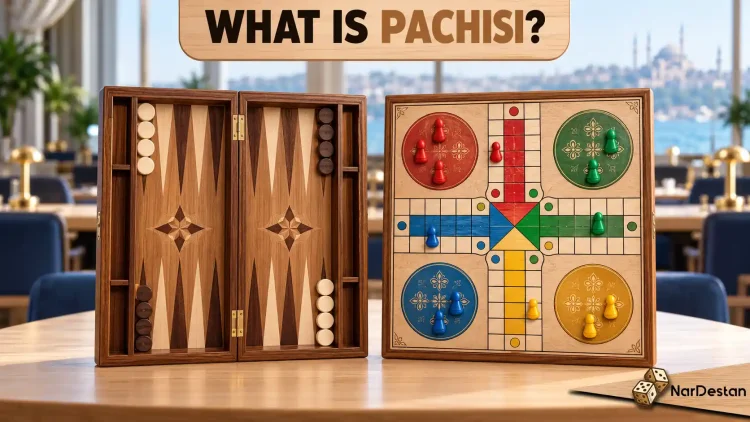
Pachisi is an ancient Indian board game somewhat resembling backgammon, played on a cross-shaped board using cowrie shells instead of conventional dice. Players move their pieces around a designated path, capture opposing pieces, and attempt to bring all their pieces safely home. Although Pachisi and backgammon share elements of strategy, luck, and piece movement, they differ significantly in board design, gameplay, and winning conditions. Pachisi is also the traditional Indian game that inspired modern board games such as Ludo and Parcheesi. Understanding its history and rules helps explain why this centuries-old game is still associated with some of the world’s most familiar board games.
What Is Pachisi?
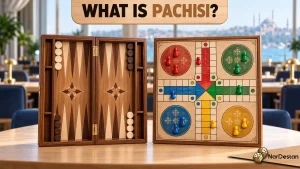
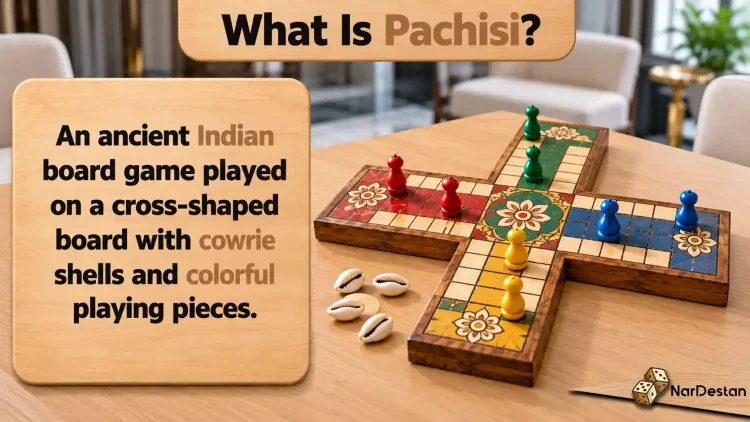
Pachisi is a traditional Indian race game usually played by four people in two teams. Each player controls four pieces and moves them along a cross-shaped board according to the results of throwing cowrie shells.
The name Pachisi comes from the Hindi word pachis, meaning twenty-five, which represents the highest possible score in a traditional throw of six cowrie shells.
The game combines several important elements:
- Strategy: Choosing which piece to move and when to capture an opponent.
- Luck: Using cowrie shells to determine movement.
- Competition: Racing to complete the board before the opposing team.
- Teamwork: Coordinating moves with a partner in traditional four-player matches.
Unlike many modern board games, traditional Pachisi often uses a cloth board with embroidered markings and cowrie shells instead of manufactured dice.
The Origin and History of Pachisi
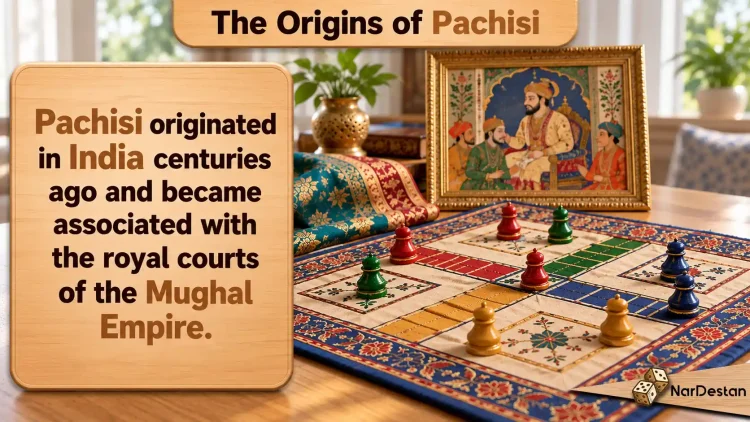
The Pachisi game originated in India and has been played for centuries. Although its precise beginnings remain uncertain, historical accounts associate the game with Indian royal courts, particularly during the Mughal period.
One famous example comes from the reign of Emperor Akbar in the 16th century. At Fatehpur Sikri, a large courtyard was designed with a board-like pattern associated with Pachisi. Historical descriptions recount games played using people as living pieces.
Over time, the traditional Indian game spread beyond the Indian subcontinent and influenced several European and American board games.
Among its most recognizable descendants are:
- Ludo: A simplified race game popular in many countries.
- Parcheesi: An American adaptation of Pachisi.
- Parchís: A Spanish version belonging to the same family of games.
These adaptations preserved the basic idea of moving pieces around a track while introducing different equipment and rules.
How Is Pachisi Played?
Learning how to play Pachisi begins with understanding the board, the pieces, and the movement system. Although traditional rules vary between regions, the basic objective remains the same: move all your pieces around the board and return them to the central home square before your opponents.
Pachisi Board and Equipment
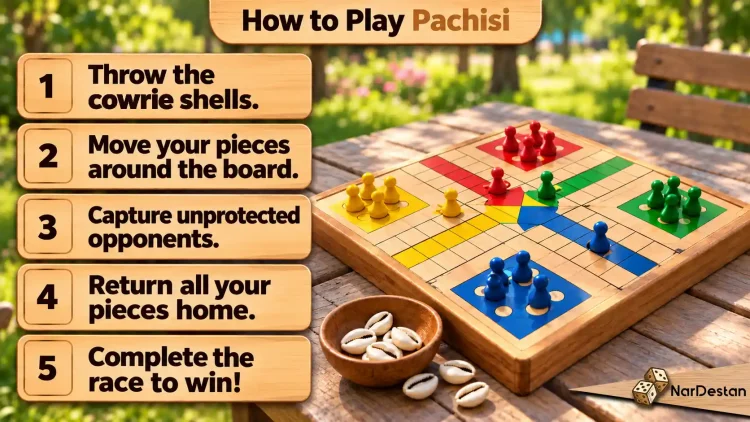
A traditional Pachisi game requires the following equipment:
| Equipment | Description |
| Board | A symmetrical cross-shaped board with four arms |
| Playing pieces | 16 pieces in four different colors |
| Players | Usually four players in two partnerships |
| Cowrie shells | Six shells traditionally used to determine movement |
| Home square | The central square, called the Charkoni |
| Safe squares | Marked spaces, often called castles, where pieces are protected from capture |
Each arm of the traditional board contains three columns of eight squares. Certain marked squares provide protection against opponents.
Basic Pachisi Board Game Rules
The following steps explain the traditional gameplay:
- Set up the board: Place the pieces in the central home area, with each player controlling four pieces of one color.
- Determine movement: Throw six cowrie shells and calculate the score according to how many land with their openings facing upward.
- Enter the board: Use a qualifying throw to bring a piece into play, according to the traditional rules.
- Move the pieces: Advance pieces along the designated route around the cross-shaped board.
- Capture opponents: Landing on an opponent’s unprotected piece sends it back to the starting area.
- Reach home: Complete the circuit and return the pieces to the central square.
In traditional partnership play, a team wins when both partners have successfully brought all their pieces home.
How Do Cowrie Shells Work in Pachisi?
Instead of rolling two numbered dice as in backgammon, traditional Pachisi uses six cowrie shells. Their positions after each throw determine how far a player may move.
One commonly documented traditional scoring system is:
| Cowrie shells facing upward | Movement score |
| 0 | 25 |
| 1 | 10 |
| 2 | 2 |
| 3 | 3 |
| 4 | 4 |
| 5 | 5 |
| 6 | 6 |
Special throws, typically 6, 10, and 25, can also grant an additional turn or allow a new piece to enter the board.
Because regional variations exist, players should agree on the scoring and movement rules before beginning a match.
Pachisi vs Backgammon: Key Differences
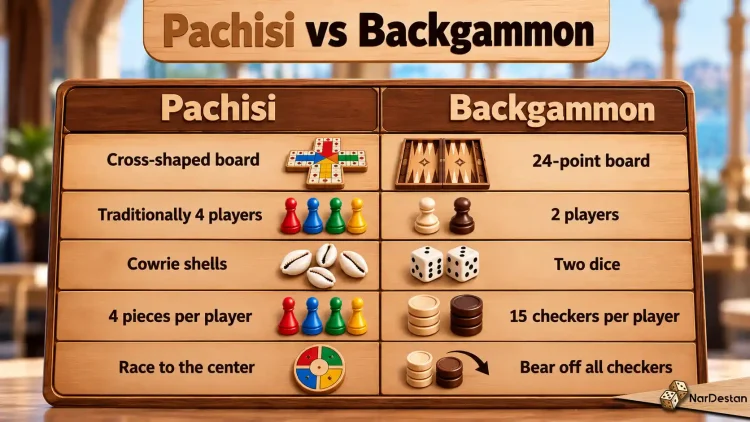
Pachisi is sometimes described as an Indian board game similar to backgammon because both involve racing pieces, capturing opponents, and balancing strategic decisions with random throws. However, these games belong to different historical traditions and use distinct rules.
| Feature | Pachisi | Backgammon |
| Origin | India | Ancient board-game traditions of the Middle East and surrounding regions |
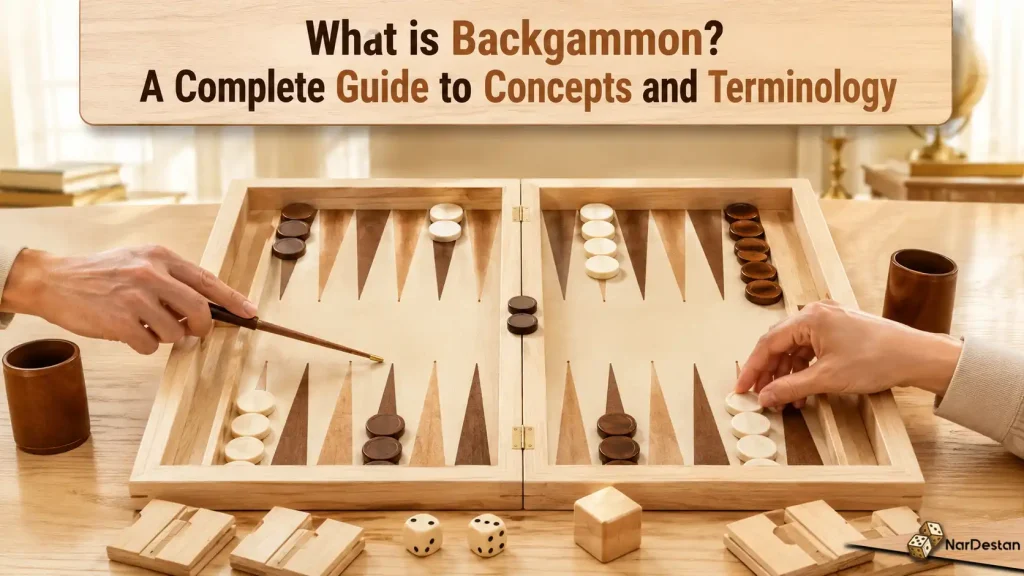
| Board design | Cross-shaped board | Rectangular board with 24 points |
| Number of players | Traditionally four in two teams | Two |
| Playing pieces | Four pieces per player | Fifteen checkers per player |
| Movement system | Traditionally six cowrie shells | Two six-sided dice |
| Capturing | Landing on an exposed opponent’s piece | Hitting a single opposing checker (blot) |
| Safe positions | Special marked squares | Points protected by two or more checkers |
| Winning condition | Completing the circuit and bringing pieces home | Bearing off all fifteen checkers |
What Makes Pachisi Similar to Backgammon?
Both games require players to move pieces strategically while responding to unpredictable throws. They also allow players to disrupt an opponent’s progress by capturing or hitting exposed pieces.
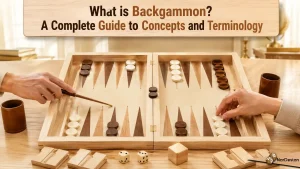
The main difference is the overall movement system. In Pachisi, players travel around a cross-shaped track toward the central home area. In backgammon, two players move checkers along a board of 24 points before bearing them off.
Therefore, Pachisi is not an Indian version of backgammon. It is an independent traditional game that shares certain gameplay characteristics.
Is Pachisi the Same as Ludo?
No. Pachisi and Ludo are closely related, but they are not identical games.
Ludo developed as a simplified adaptation of Pachisi and became popular in Britain during the late 19th century. It retains the general concept of moving pieces around a cross-shaped track and returning them home.
However, Ludo generally uses a numbered die instead of cowrie shells, and its rules are easier for beginners to learn.
Pachisi vs Ludo
| Feature | Pachisi | Ludo |
| Historical origin | Traditional Indian game | Later adaptation of Pachisi |
| Movement equipment | Cowrie shells | Usually one six-sided die |
| Gameplay | More detailed traditional rules | Simplified movement rules |
| Team play | Traditionally played in partnerships | Commonly played individually |
| Board | Traditional cross-shaped track | Modern cross-shaped board |
| Special scoring | Includes throws worth 10 or 25 | Uses standard die values |
While Ludo is more widely recognized internationally, Pachisi remains important as a historical board game that influenced the development of modern race games.
Parcheesi vs Pachisi: Are They Different?
Parcheesi is an American adaptation of Pachisi. Both games share the concept of moving pieces around a board and sending opposing pieces back to their starting positions.
However, standard Parcheesi uses dice, manufactured game boards, and its own rules for entering pieces, moving, capturing, and reaching home.
Consequently, Pachisi, Ludo, and Parcheesi belong to the same broader family of games but should not be treated as having identical rules.
Conclusion about Pachisi
Pachisi is the answer to the question, “What is an Indian game somewhat resembling backgammon?” This traditional Indian board game combines strategic piece movement, cowrie-shell throws, and competitive racing on a distinctive cross-shaped board.
Although Pachisi and backgammon share some fundamental gameplay concepts, their rules and board structures are different. Pachisi also holds an important place in board-game history as the predecessor of Ludo and Parcheesi, connecting a traditional Indian pastime with games enjoyed around the world.
Frequently Asked Questions About Pachisi
What is the Indian game somewhat resembling backgammon?
The game is Pachisi, a traditional Indian board game played on a cross-shaped board using cowrie shells to determine movement.
Is Pachisi an Indian game like backgammon?
Yes. Pachisi resembles backgammon in its combination of strategy, chance, piece movement, and capturing, but the two games have different boards and rules.
What does Pachisi mean in English?
Pachisi comes from a Hindi word meaning twenty-five, referring to the highest score possible in a traditional throw of six cowrie shells.
How many players can play Pachisi?
Traditional Pachisi is usually played by four players divided into two teams, although two-player variations also exist.
What is the difference between Pachisi and backgammon?
Pachisi uses a cross-shaped board and traditionally uses cowrie shells, while backgammon uses a 24-point board and two dice. Their winning conditions and movement systems also differ.
Is Pachisi the original version of Ludo?
Yes. Ludo developed from Pachisi as a simplified board game with more standardized rules.
Is Pachisi still played today?
Yes. Traditional forms of Pachisi remain part of South Asian gaming culture, while related games such as Ludo, Parchís, and Parcheesi are played internationally.