


Jacquet is a traditional two-player board game that closely resembles backgammon but has several important differences in its rules, starting positions, and checker movements. The most notable differences between Jacquet and backgammon include the use of a leading checker called the postillon, both players moving in the same direction, and the absence of hitting opposing checkers. These features make Jacquet a distinct strategic game rather than simply another name for backgammon. In this guide, we’ll explore what Jacquet is, its French origins, how to play it, and the essential rules that distinguish it from standard backgammon.
What Is Jacquet?
Jacquet is a traditional two-player dice and strategy board game belonging to the backgammon family. Each player controls 15 checkers and aims to move all of them around the board and bear them off before their opponent.
One of Jacquet’s most distinctive features is that the game begins with only one checker in motion. This leading checker, known as the postillon, must reach the fourth quarter of the board before the player can move any of their remaining 14 checkers.
Unlike modern backgammon, Jacquet does not allow players to hit opposing checkers. Instead, players compete by occupying points, controlling movement, and strategically blocking their opponent’s available landing spaces.
Jacquet in France: History and Origins
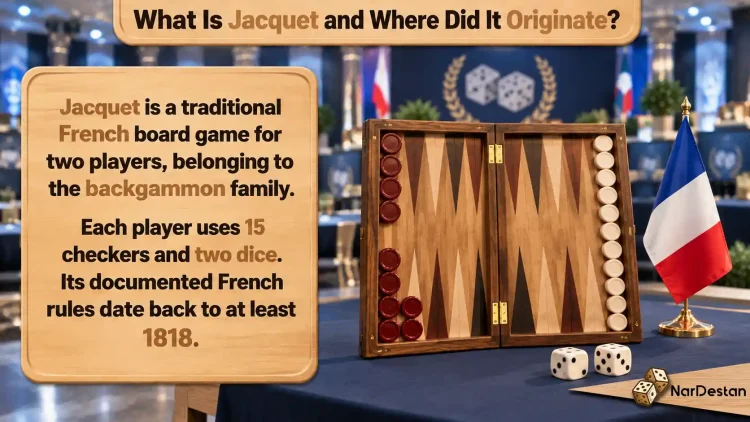
Jacquet is particularly associated with France, where it became a popular traditional board game during the 19th century. One of the earliest known published descriptions of its French rules dates back to 1818.
As the more complicated French game Trictrac gradually declined in popularity, Jacquet became a widely played alternative. It remained popular in France well into the 1960s.
Although Jacquet developed as a traditional French game, it shares the broader historical roots of backgammon, a board game with a much longer history. Jacquet is not simply the French name for modern backgammon. It has its own distinctive checker arrangement, movement system, and strategic rules.
Differences Between Jacquet and Backgammon
The differences between Jacquet and backgammon go far beyond the starting arrangement of the checkers. In standard backgammon, players move in opposite directions and can hit exposed opposing checkers. Jacquet, however, uses a different movement system in which both players travel around the board in the same direction, and even a single opposing checker blocks a point. If you’re new to the game, our guide on how to play backgammon explains the basic rules, checker movements, and winning strategies.
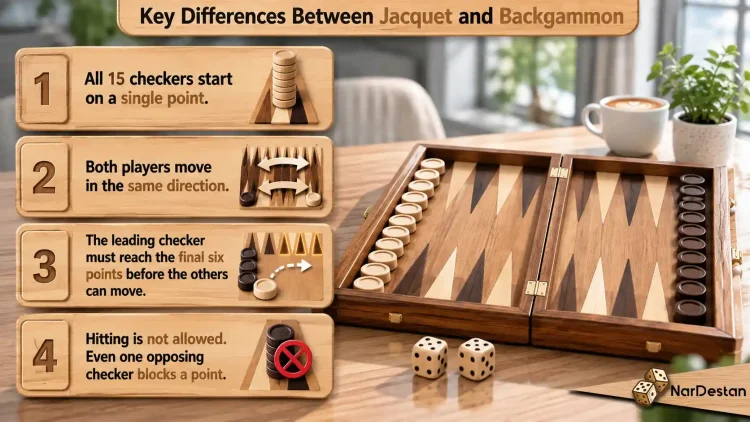
The following table compares traditional French Jacquet with standard backgammon.
| Feature | Jacquet | Standard Backgammon |
| Starting position | All 15 checkers begin on one point | Checkers are distributed across four points in groups of 2, 5, 3, and 5 |
| Direction of movement | Both players move in the same direction | Players move in opposite directions |
| First checker to move | Only the postillon can move initially | Any checker with a legal move can be played |
| Releasing other checkers | The postillon must reach the fourth quarter | No special requirement |
| Hitting opposing checkers | Not allowed | Allowed when an opposing checker is alone |
| Blocking a point | One checker is sufficient | At least two checkers are required |
| Blocking restrictions | Certain versions restrict complete blockades, especially against the postillon | A six-point prime is permitted |
| Main strategic focus | Checker advancement, point occupation, and route management | Checker advancement, making points, hitting, and risk management |
| Winning objective | Bear off all 15 checkers first | Bear off all 15 checkers first |
In short, Jacquet emphasizes movement and positional control, while standard backgammon also involves hitting, re-entering checkers, and managing exposed checkers.
Equipment Needed to Play Jacquet
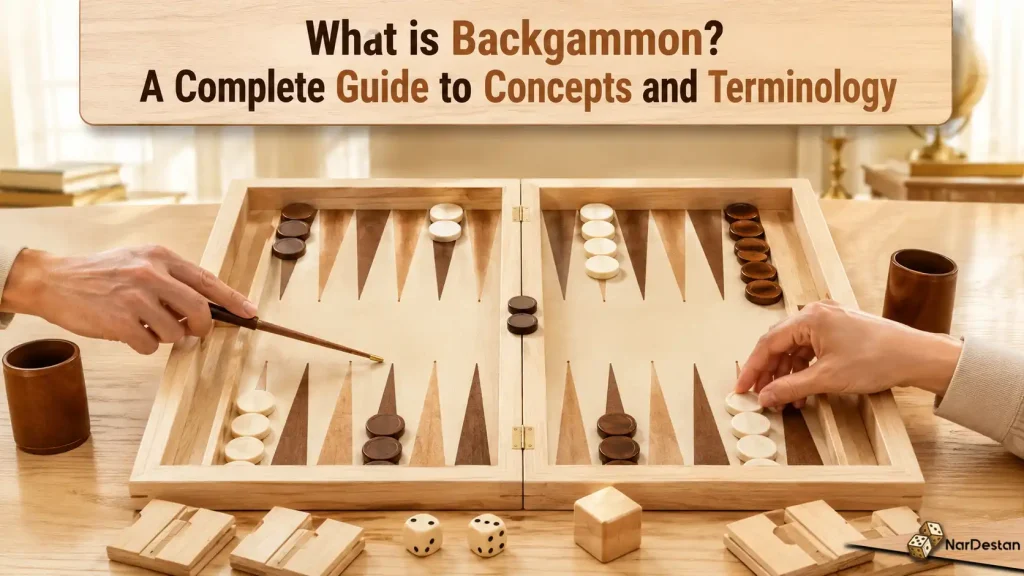
Jacquet uses equipment similar to standard backgammon. You will need a board with 24 triangular points, 30 checkers in two different colors, and two dice.
Each player controls 15 checkers, and the board is divided into four sections containing six points each. A dice cup may also be used. You do not need to purchase a special Jacquet board. A regular backgammon board with a complete set of checkers and dice is sufficient.
Jacquet Starting Position: How to Set Up the Board
Unlike standard backgammon, where checkers are distributed across several points, Jacquet begins with all 15 checkers of each player stacked on a single starting point, traditionally called the talon.
The two players’ starting points are located in diagonally opposite corners of the board.
To visualize the arrangement, imagine looking down at the board from above. One player places all 15 checkers in the bottom-left corner, while the other places their checkers in the top-right corner. Each player begins moving their checkers from their respective starting position, following the established direction of play.
Direction of Movement and Objective of Jacquet
In traditional French Jacquet, both players move their checkers counterclockwise around the board. This is a significant difference from standard backgammon, where the players move in opposite directions.
Each player must move their checkers through the four quarters of the board and eventually bring them into their final six-point section, also known as the home board.
The objective is to bear off all 15 checkers before your opponent.
However, reaching the end of the track with a single checker is not enough. Before bearing off can begin, all remaining checkers must be gathered in the player’s home board.
What Is the Postillon in Jacquet?
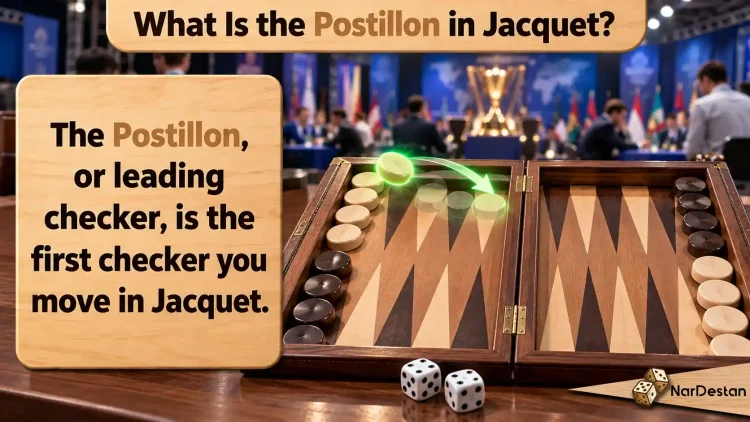
The postillon is the leading checker that must move first in Jacquet. This checker plays a crucial role in the opening stage because the player cannot move their other 14 checkers until the postillon reaches the fourth quarter of the board.
Traditionally, the postillon is positioned near the pointed end of its triangular board point, making it easier to distinguish from the other checkers.
Once the postillon reaches the final quarter, the remaining checkers become available for movement. From that point onward, the leading checker follows the same general movement rules as the other checkers.
The postillon rule makes the opening phase of Jacquet particularly important, as players must advance their leading checker while considering the points occupied by their opponent.
How to Play Jacquet: Essential Rules
The basic rules of Jacquet are relatively straightforward, but some traditional versions introduce additional restrictions on blocking and bearing off.
Before starting, players should agree on which variation of the rules they will follow. The following sections explain the core movement rules and identify areas where different versions may apply.
1. Rolling the Dice, Moving Checkers, and Doubles
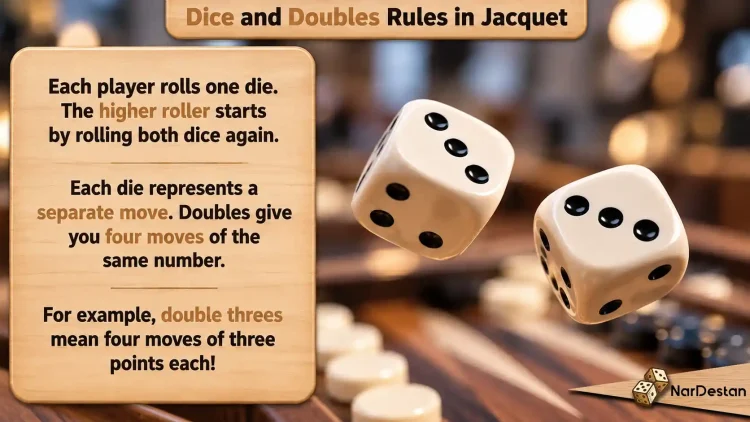
To determine who moves first, each player rolls one die. The player with the higher number wins the opening roll, rolls both dice again, and begins the game.
On each turn, the two dice represent two separate moves. Players may use both numbers to move a single checker or distribute them between two different checkers, provided each move is legal. During the opening phase, however, only the postillon may move until it reaches the fourth quarter.
Rolling doubles allows four moves instead of two. For example, rolling double threes gives the player four separate three-point moves.
The following movement principles apply:
- If both dice can be played legally, the player must use both.
- If only one die can be played, that move must be made.
- If either die can be played individually but both cannot be used, the higher number takes priority.
- When doubles are rolled, the player must make as many of the four legal moves as possible.
These rules require players to carefully evaluate their available moves rather than simply combining the dice into one number.
2. Legal Moves and Blocking Rules in Jacquet
A checker may land only on an empty point or a point already occupied by the same player’s checkers.
Even a single opposing checker makes a point unavailable for landing.
This restriction also applies to intermediate landing points when both dice are used to move the same checker. For example, rolling a 3 and a 5 does not automatically allow a checker to jump eight points forward. The intermediate landing point after the first move must also be legal.
Some traditional Jacquet variations include additional blocking restrictions:
- Completely blocking the postillon’s path with six consecutive occupied points is prohibited.
- In certain versions, a player may occupy all six points of their first quarter only if their final point is already occupied.
- A stricter variation requires the final two points to be occupied before completing that blockade.
These restrictions are not identical across all historical versions of Jacquet. Players should clarify the rules before beginning a match.

Can You Hit an Opponent’s Checker in Jacquet?
No. Hitting or capturing an opposing checker is not allowed in traditional French Jacquet.
Unlike standard backgammon, a player cannot land on a point occupied by an opponent’s checker, even when that point contains only one checker. As a result, Jacquet has no equivalent of the backgammon bar, and players do not need to re-enter checkers after being hit. A single checker is therefore safe from being captured. However, it can still create movement restrictions for the opposing player. This makes strategic point occupation especially important, as controlling valuable landing points can limit an opponent’s available moves.
Bearing Off Rules in Jacquet
Under the basic Jacquet rules, bearing off begins once all 15 checkers have reached the player’s final six-point section.
Players then use their dice to remove checkers from the corresponding points. For example, rolling a 4 allows a player to bear off a checker from the four-point position.
If the number rolled is higher than the distance of the farthest checker from the exit, the player may bear off that farthest checker instead.
For instance, if a player rolls a 6 and has no checkers on points 6 or 5, they may bear off a checker from point 4, provided no checkers remain farther from the exit. In some advanced Jacquet variations, bearing off may also depend on whether the opponent’s starting point has been cleared. This additional condition does not apply to every version of the game.
Jacquet Strategy: Essential Tips for Beginners
Learning Jacquet becomes easier when players initially focus on legal movement, point control, and the position of the postillon. Before making a move, examine each die separately and consider whether the chosen move is permitted under the agreed rules.
Manage Your Postillon Carefully
The postillon controls the opening stage of Jacquet. Until it reaches the fourth quarter, the rest of your checkers must remain at their starting point. When using both dice to advance the postillon, consider both possible movement orders.
For example, one sequence might lead to a blocked intermediate point, while reversing the order could produce a legal move. Remember that the final destination alone does not determine whether the entire move is legal.
Advance Your Checkers and Control Key Points
Once your postillon releases the other checkers, avoid focusing exclusively on advancing a single checker. Pay attention to the checkers left behind and the points that become vacant when you move.
Occupying an important point can restrict your opponent’s available landing spaces. However, maintaining a blockade should not prevent your own checkers from making progress. Effective Jacquet strategy involves balancing forward movement with positional control.
Common Backgammon Mistakes to Avoid in Jacquet
Players familiar with backgammon may accidentally apply standard backgammon rules when learning Jacquet.
Avoid these common mistakes:
- Using the standard backgammon starting arrangement.
- Assuming the players move in opposite directions.
- Moving other checkers before the postillon reaches the fourth quarter.
- Treating a point occupied by one opposing checker as open.
- Ignoring intermediate landing points when combining dice movements.
- Applying blocking restrictions from one Jacquet variation to another without checking the rules.
Understanding these differences helps prevent illegal moves and makes the transition from backgammon to Jacquet much easier.
Jacquet vs. Backgammon: Which Game Should You Play?
Choosing between Jacquet and backgammon depends largely on the type of strategy you enjoy.
If you prefer hitting opposing checkers, managing exposed checkers, and adapting to sudden changes caused by re-entry, standard backgammon may be more appealing.
On the other hand, if you enjoy competing for valuable points, managing movement routes, and restricting your opponent without capturing checkers, Jacquet offers a different strategic experience.
For experienced backgammon players, Jacquet provides an opportunity to explore a new set of decisions using almost the same equipment.
Neither game is necessarily easier or more difficult. The best way to discover which one you prefer is to play several matches and compare their gameplay. Finally both games require strategic thinking, but the role of skill and luck in backgammon strategy makes each match unpredictable.
Conclusion: Understanding the Differences Between Jacquet and Backgammon
The three main differences between Jacquet and backgammon are the special role of the postillon, both players moving in the same direction, and the absence of hitting opposing checkers. In Jacquet, even a single checker can block a point, making positional control and careful route planning essential parts of the game. If you are already familiar with backgammon, learning Jacquet can introduce you to a different style of strategic board play. Start by understanding the initial setup and movement rules, then agree on the blocking and bearing-off regulations before your first match.
Frequently Asked Questions About Jacquet
Is Jacquet the Same as French Backgammon?
Jacquet is a traditional French board game from the backgammon family, but it is not simply the French name for standard backgammon. Its starting positions, movement direction, and rules are different.
Do You Need a Special Board to Play Jacquet?
No. You can play Jacquet using a standard backgammon board, 15 checkers per player, and two dice.
How Are the Checkers Arranged at the Start of Jacquet?
Each player places all 15 checkers on a single starting point. The two starting points are located in diagonally opposite corners of the board.
When Can You Move the Other Checkers in Jacquet?
You can move the remaining 14 checkers once your postillon reaches the fourth quarter, which is the final six-point section of its route.
Can You Hit a Single Opponent’s Checker in Jacquet?
No. Even one opposing checker blocks a point. Jacquet does not allow hitting checkers or re-entering them from a bar.
Can Checkers Pass Over Blocked Points in Jacquet?
Yes. Checkers may pass over occupied points as long as every required landing point is legal. When using both dice for one checker, the intermediate landing point must also be available.
What Happens When You Roll Doubles in Jacquet?
Rolling doubles gives you four moves of the same number. For example, double fours allow four separate four-point moves. You must make as many legal moves as possible.
Can You Completely Block Your Opponent’s Postillon?
In variations with blocking restrictions, creating a complete six-point blockade against the opponent’s postillon is prohibited. Players should agree on the applicable rules before starting.
When Can You Start Bearing Off in Jacquet?
Under the basic rules, you can begin bearing off once all 15 checkers have reached your final six-point section.
Why Do Jacquet Rules Vary Between Sources?
Jacquet has several historical variations. Blocking restrictions, bearing-off conditions, and scoring rules may differ depending on the version being played.