



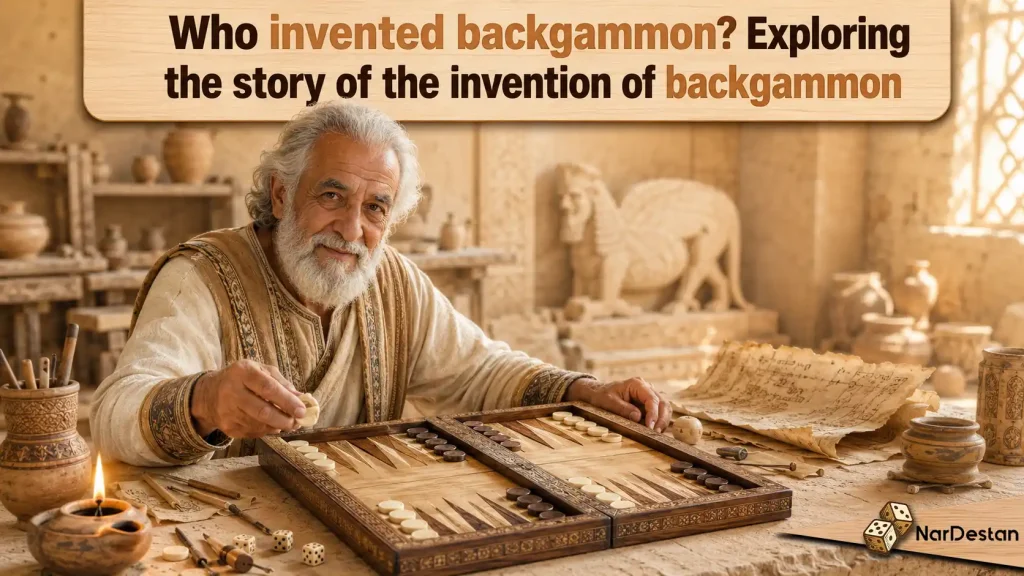
Who is the inventor of backgammon? What is the story behind its invention? Backgammon is one of the oldest games in the world, tracing its origins back to ancient civilizations such as Sumer, Egypt, and India; however, its modern, coherent form was created in ancient Iran. Some attribute its invention to Ardashir Babakan, while others say that Bozorgmehr, the wise vizier of Khosrow Anushirvan, designed the game. At that time, few probably imagined that these simple boards made of wood and stone would one day become so popular that international backgammon tournaments would be held worldwide, bringing together countless backgammon champions.
If you want to learn more about the inventor of backgammon and the origins of the world’s first backgammon board, stay with Nardestan until the end of this article.
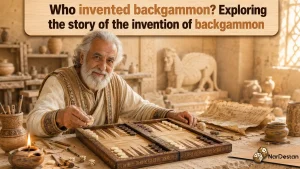
Who is the Inventor of Backgammon?
As we discussed in the article “What is Backgammon?”, the invention of this game dates back to antiquity and ancient civilizations. But the important question remains: who designed this fascinating game for the first time? Who is credited with inventing backgammon, and what is the philosophy behind its creation?
Many researchers believe that backgammon, unlike inventions credited to a single individual, is the result of the gradual evolution of thought and gaming across ancient civilizations. Some sources trace the philosophical origins of backgammon to the Sumerians, Egyptians, and Indians, even suggesting that it is the product of the mutual influence of all three cultures. However, what stands out most prominently in history is the role of Iranian civilization in finalizing the shape and giving identity to this game.
The Story of Backgammon’s Invention in Ancient Iran
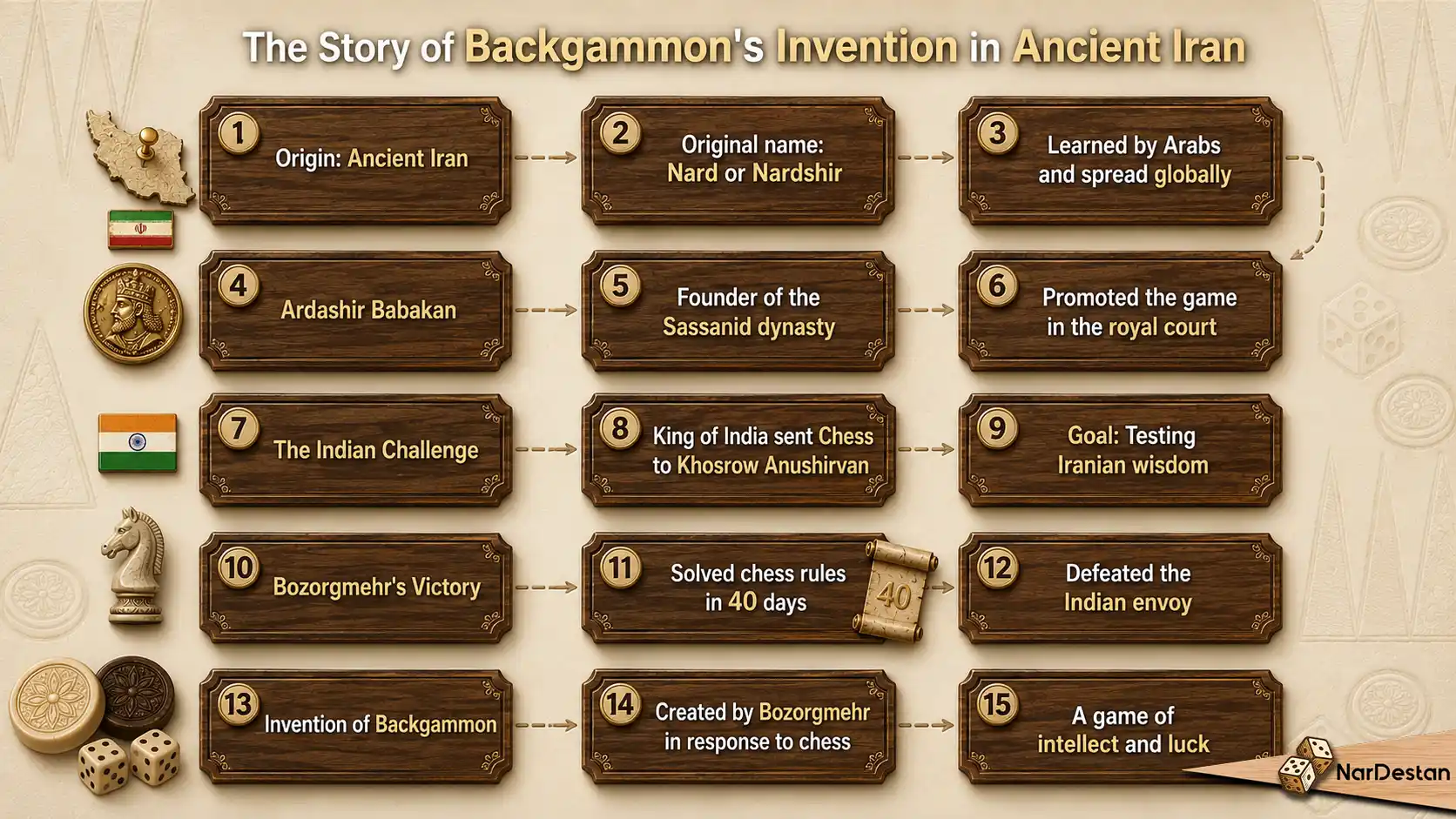
A review of historical sources reveals that the answer to “which country invented backgammon?” points to ancient Iran more than any other land. What is stated with great certainty in historical texts is that the game Crusader knights observed during their battles with the ruling Arabs in Spain and North Africa was known as “Nard” or “Nardshir”. The Arabs had learned this game from the Iranians and subsequently spread it to other regions—a historical event that highlights Iran’s pivotal role in transmitting and popularizing the game globally.
Many historians believe that the word “Nardshir” is derived from the name of Ardashir Babakan. Ardashir Babakan, the renowned king and founder of the Sassanid dynasty, is a figure whom some consider the true inventor of backgammon, while others view him at least as the ultimate promoter and organizer of the game. According to this perspective, backgammon found a special place as an official court game during the Sassanid era, becoming an integral part of Iran’s aristocratic and intellectual culture. Consequently, many consider Iran to be the birthplace of the world’s first backgammon in its modern, recognized format.
Alongside this theory, another famous and influential narrative is found in historical sources such as the History of the Prophets and Kings (Tarikh al-Tabari) and Tarikh-e Sistan—a narrative that links the story of backgammon to the reign of King Khosrow Anushirvan. According to this legend, the King of India, wishing to test the wisdom and knowledge of the Iranians, sent a magnificent chess set featuring pieces made of rubies and emeralds, along with precious gifts, to the Iranian court. In his letter to Anushirvan, he declared that if Iranian scholars could decipher the secret rules of this game, supremacy would belong to Iran; if they failed, Iran would have to pay tribute to India.
Anushirvan requested forty days to respond. During this period, none of the court scholars could unravel the mechanics of chess. Finally, on the fortieth day, Bozorgmehr, the king’s young and brilliant vizier, thoroughly explained the rules. Following this, Bozorgmehr sat down to play against the Indian envoy, securing back-to-back victories and demonstrating the superiority of Iranian wisdom.
According to history, after this victory, Bozorgmehr introduced a brand-new game—a game based not only on intellect but also on the unpredictable role of luck and destiny. This game was backgammon, which later became known as the world’s first formally structured backgammon. From then on, backgammon steadily gained popularity across Iran, the Middle East, and eventually the entire world. (If you also want to become a formidable player, we recommend reading our article on “Common Backgammon Mistakes”.)
Which Country Invented Backgammon?
The answer to “which country invented backgammon” comes with varying perspectives among historians. However, broadly speaking and according to extensive research, the world’s first true backgammon is attributed to ancient Iran. As mentioned above, historical evidence indicates that the structured and recognized form of backgammon emerged in Iran during the Sassanid Empire.
While some researchers suggest that primitive roots of similar board games existed in civilizations like Sumer, Egypt, or India, none of these cultures presented the complete, philosophy-driven form of the game we play today. What is certain from historical records is that the game which eventually made its way to Europe—where it became known as Backgammon—was transmitted via Iran and the Islamic world. (If you’re curious about how the game is played abroad and what the English terminology is, be sure to read our related article comparing Iranian and Western backgammon.)
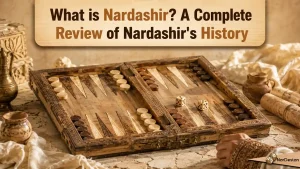
What Did the World’s First Backgammon Look Like?
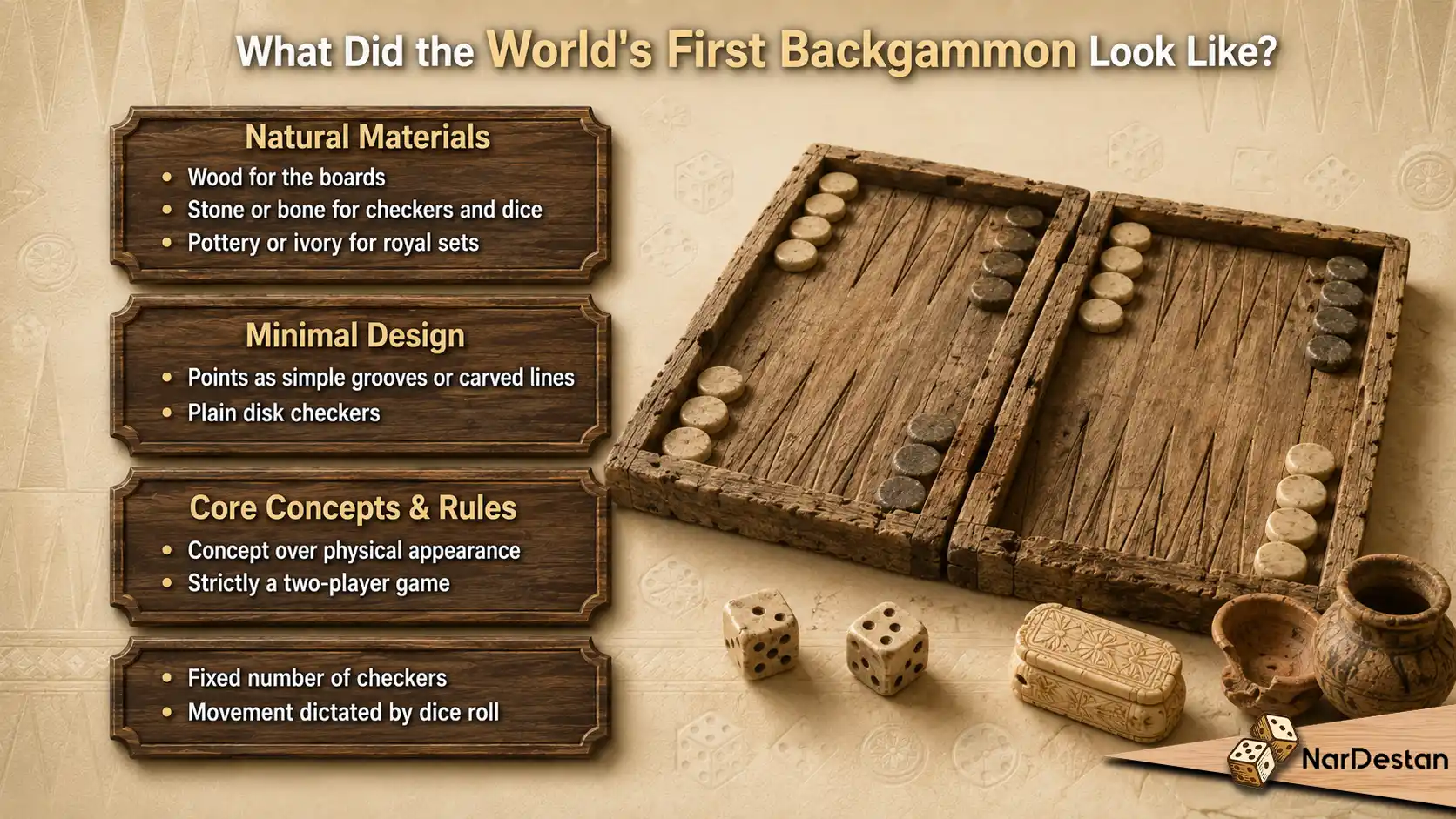
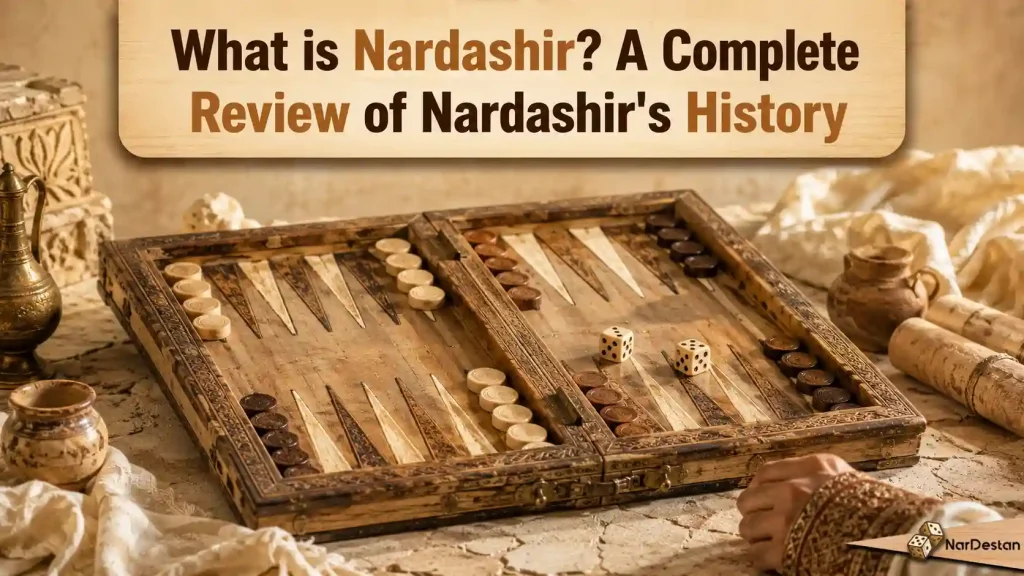
To better understand the history of this ancient game, we must look at what the original boards looked like. Unlike today’s delicate, highly ornamented backgammon sets, the early versions were simple, highly practical, and crafted using the resources available at the time. Yet, even within this simplicity lay profound concepts regarding life, time, and fate.
Based on historical and archaeological findings regarding who invented backgammon, early boards were typically crafted from natural, accessible materials, including:
- Wood (especially in Iran and other forested regions)
- Stone or bone for the checkers
- Occasionally pottery or ivory for royal and aristocratic sets
The design of the boards was generally straightforward, devoid of elaborate decorations. The playing surface was either a flat or folding board, with the “points” marked as simple grooves, carved lines, or primitive motifs. The checkers were usually plain disks, and the dice were carved from bone or stone.
The most crucial aspect of the world’s first backgammon was that the underlying concept of the game mattered far more than its physical appearance. For instance, while the rules were slightly simpler than today’s, key mechanics like hitting and bearing off were more or less present. In the earliest versions of the game:
- The number of checkers was defined and fixed.
- Movement was dictated by the roll of the dice.
- The competition was strictly a two-player endeavor.
The Difference Between Ancient and Modern Backgammon
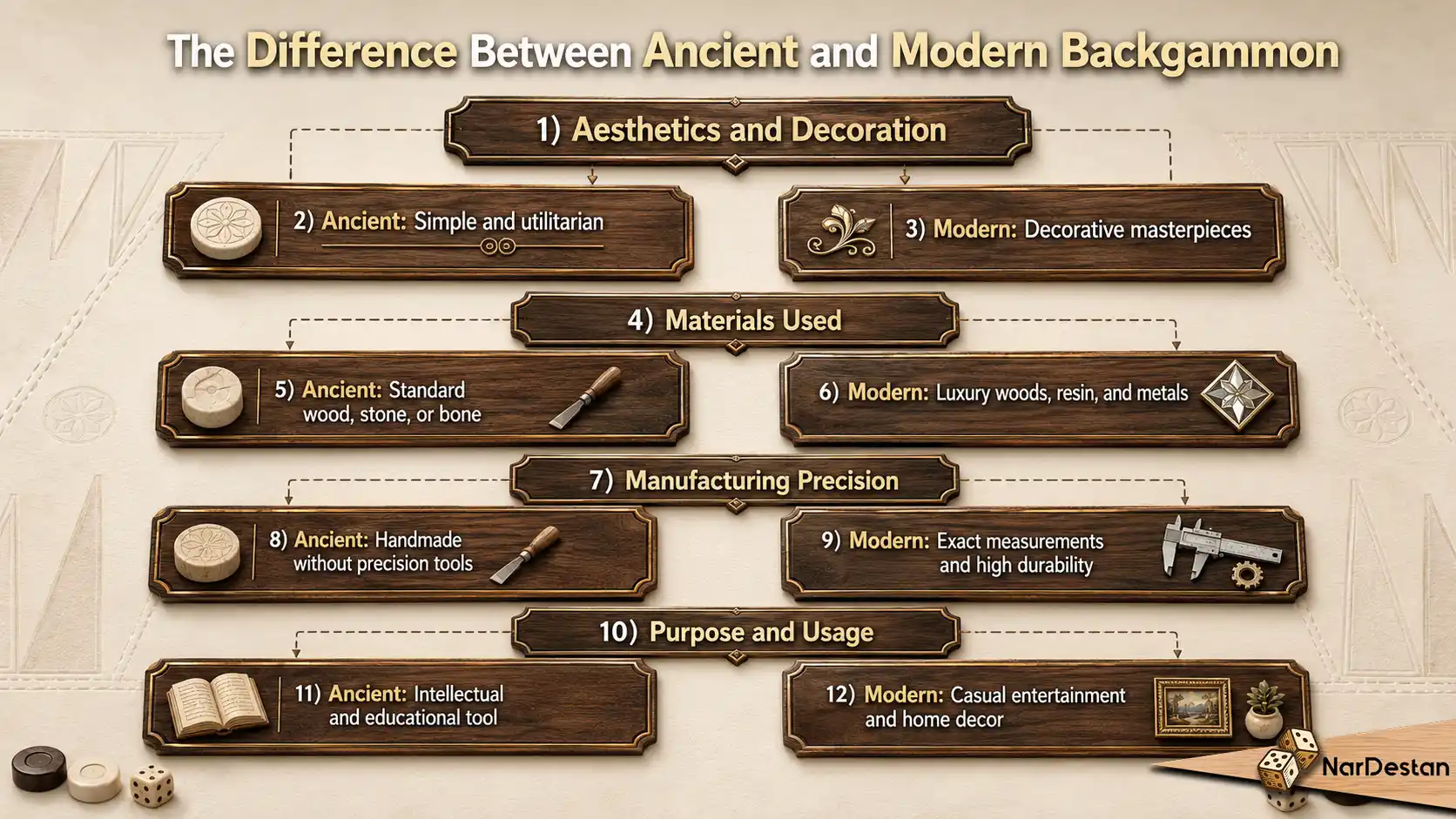
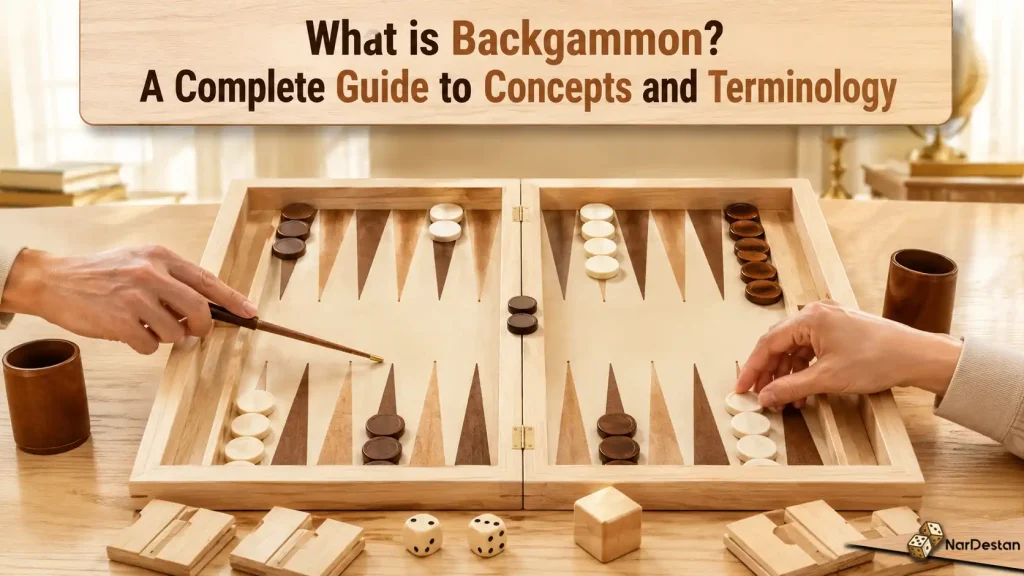
Today’s backgammon sets differ significantly from their ancient counterparts. These differences aren’t just cosmetic; they highlight how the game has evolved from a purely intellectual tool of the past into a piece of art and entertainment in the modern world. Exploring these differences inevitably brings us back to the foundational questions: Who is the inventor of backgammon? Which country invented it? And how did the first sets take shape?
- Aesthetics and Decoration: Ancient boards were simple and utilitarian. Their primary purpose was to facilitate the game and reflect its hidden intellectual philosophies. In contrast, modern backgammon boards are often crafted using exquisite arts like Khatam-kari (marquetry), Monabat (wood carving), and Moarraq (mosaic), occasionally featuring leather or metal elements. Today, many sets resemble decorative masterpieces rather than mere gaming devices.
- Materials Used: Historically, backgammon was made from local, natural materials like standard wood, stone, or bone. Today, craftsmen utilize premium luxury woods, resin, metals, and advanced synthetic materials. This shift reflects the passage of time and humanity’s changing relationship with the game.
- Manufacturing Precision: Ancient boards, while practical, were mostly handmade without precision tools. Modern sets boast exact measurements, perfect symmetry, and high durability. While this technical precision highlights industrial progress, the ancient spirit of the game remains entirely intact.
- Purpose and Usage: In the past, backgammon was heavily intellectual, educational, and often a courtly tool used to measure a person’s wisdom, patience, and strategic thinking. Today, while it retains its intellectual depth, it is widely used for casual entertainment, friendly competition, and home decor. This proves that the core philosophy of backgammon—the delicate balance of intellect and luck—is still very much alive.
Final Words: The Story of Backgammon’s Invention
As we explored in this article, the roots of this captivating game trace back to Mesopotamian civilizations some 5,000 years ago. Whether we credit its refined invention to Ardashir Babakan or the immense wisdom of Bozorgmehr during Khosrow Anushirvan’s reign, backgammon is far more than just a simple pastime. It is a profound symbol of the Iranian perspective on life—a realm where intellect, choices, and sheer luck intertwine to create meaning. This deep-rooted philosophy is the true secret behind its centuries-long endurance.
Frequently Asked Questions
Who is the inventor of backgammon?
Backgammon was not invented by one specific individual, but its formalized invention is widely attributed to Ardashir Babakan or the wise vizier Bozorgmehr during the Sassanid era.
Which country invented backgammon?
The roots and the coherent, recognized structure of modern backgammon trace back to ancient Iran.
What did the world’s first backgammon look like?
The earliest backgammon sets were incredibly simple, made of basic wood or stone, featuring primitive checkers and carved dice.
What are the origins and philosophy of backgammon?
Backgammon serves as a metaphor for life, illustrating how human intellect, strategic choices, and unpredictable luck all operate side by side.
What is the difference between ancient and modern backgammon?
Ancient backgammon sets were simple and purely functional. Modern versions, however, are highly precise, decorative, and often crafted from expensive, luxurious materials.
Is backgammon just an entertaining game?
No, historically, backgammon has been an intellectual and educational tool, functioning as a representation of human strategy and the broader philosophy of life.